|
Elastic Stack 5 : Install Logstash
2017/05/07 |
|
Install Logstash which collects or manages various logs.
For description of Logstash or how to write the setting file, refer to official site below.
⇒ https://www.elastic.co/guide/en/logstash/current/index.html |
|
| [1] | Install Logstash. Configure Repository for Elasticsearch before it like here. |
|
[root@dlp ~]# yum -y install logstash
|
| [2] | Create a setting file and start Logstash. For example, create a setting that Logstash collects sshd fail logs from [/var/log/secure]. |
|
[root@dlp ~]#
vi /etc/logstash/conf.d/sshd.conf # create new # extract sshd fail logs from [/var/log/secure] and output to index [sshd_fail-yyyy.mm] in elasticsearch
input {
  file {
    type => "seucure_log"
    path => "/var/log/secure"
  }
}
filter {
  grok {
    add_tag => [ "sshd_fail" ]
    match => { "message" => "Failed %{WORD:sshd_auth_type} for %{USERNAME:sshd_invalid_user} from %{IP:sshd_client_ip} port %{NUMBER:sshd_port} %{GREEDYDATA:sshd_protocol}" }
  }
}

output {
  elasticsearch {
    index => "sshd_fail-%{+YYYY.MM}"
  }
}
chgrp logstash /var/log/secure [root@dlp ~]# chmod 640 /var/log/secure [root@dlp ~]# systemctl start logstash [root@dlp ~]# systemctl enable logstash
|
| [3] | Few minutes later, make sure logs are collected normally. |
|
# show index list [root@dlp ~]# curl localhost:9200/_cat/indices?v health status index uuid pri rep docs.count docs.deleted store.size pri.store.size yellow open .kibana FGjE6bGUTlioELtM_QynMQ 1 1 2 0 7.7kb 7.7kb yellow open sshd_fail-2017.05 owhoRGiwTWGdZaqKAMw66g 5 1 13 0 43.7kb 43.7kb # show document list on index [root@dlp ~]# curl localhost:9200/sshd_fail-2017.05/_search?pretty
{
  "took" : 1,
  "timed_out" : false,
  "_shards" : {
    "total" : 5,
    "successful" : 5,
    "failed" : 0
  },
  "hits" : {
    "total" : 13,
    "max_score" : 1.0,
    "hits" : [
      {
        "_index" : "sshd_fail-2017.05",
        "_type" : "seucure_log",
.....
.....
|
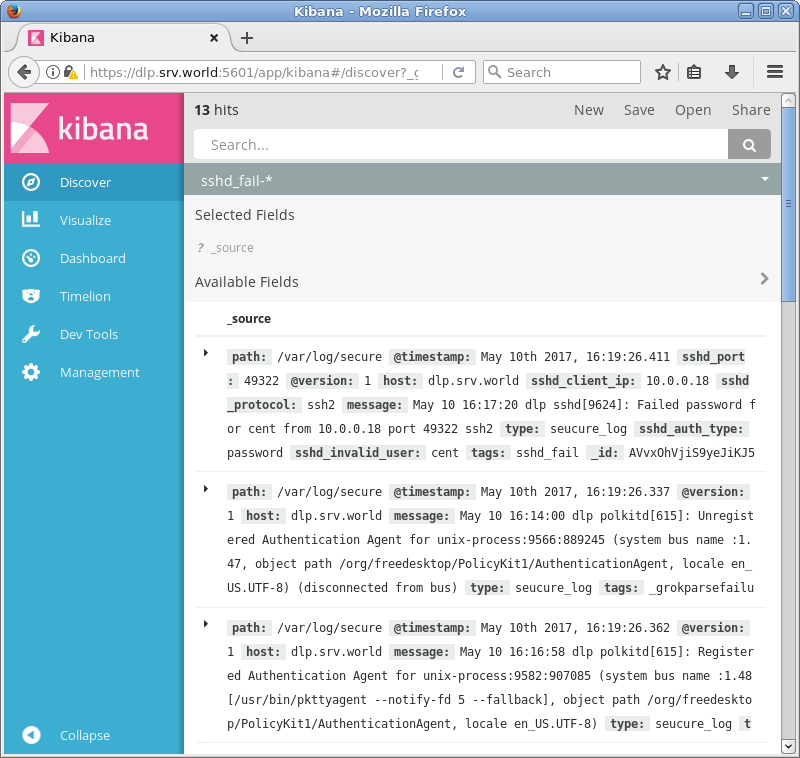
| [4] | To add the Index in Kibana, data is imported in it and possible to create visualization you like. |
|